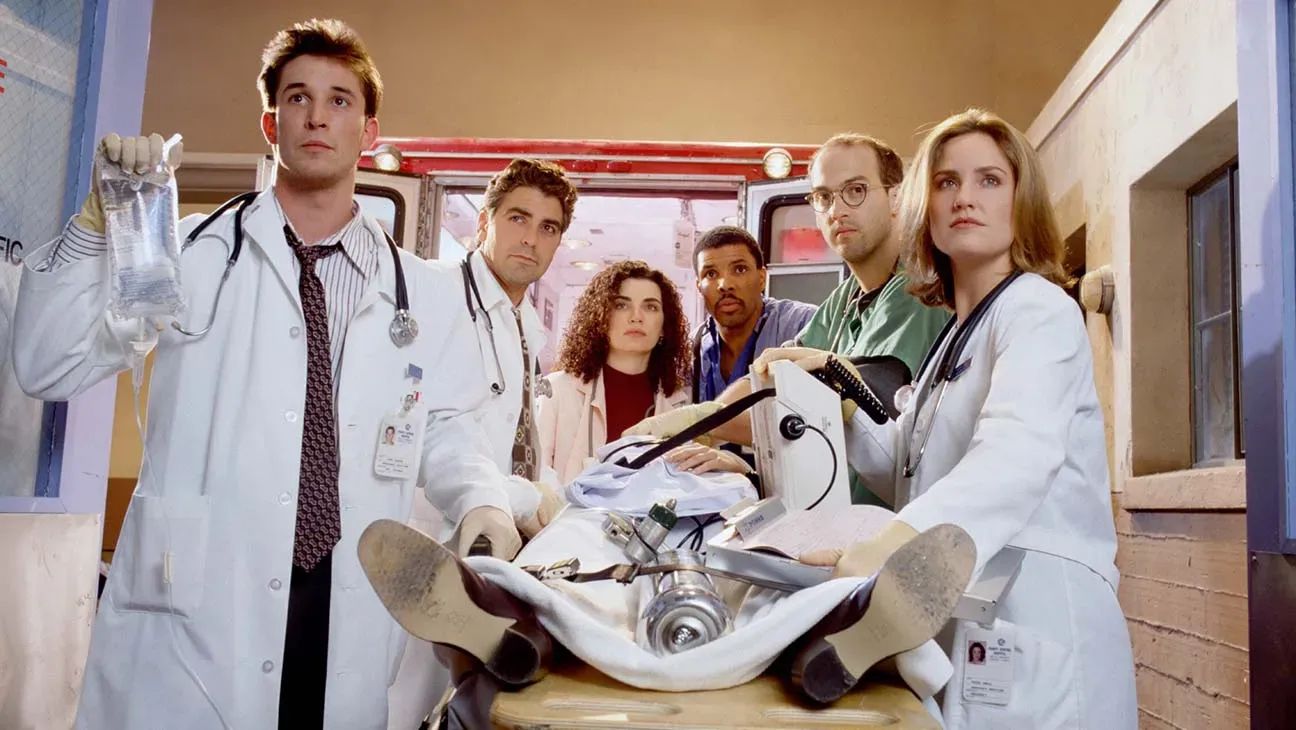
ER and, Oh God, Won't Someone Think of the Artists

I don't think I'm alone in this but I've been rewatching ER now that it's on Netflix. It's a fun exercise in being baffled by your own memory – genuinely did not remember that Corday and Greene were a thing? Had no idea Benton had a son with Renee from Ally McBeal? But the trains outside Carol's house seared on my brain. But the thing I've been thinking about a lot is how much career stability is this one show responsible for?
I'm sorry if you're already aware of how things work, but I'm going to explain residuals for those who don't know. I'm going to explain via the medium of Pedro Pascal.
Pedro Pascal was in the season four premiere of Buffy the Vampire Slayer. (Spoilers for the season four premiere of Buffy the Vampire Slayer). He played a random student Buffy talked to briefly who then disappears – and briefly reappears as a vampire and gets staked.
It's not a big role, two or three scenes, but because of that role he was able to keep chipping away at a career for the next fifteen years until he was cast as the sexiest thing any of us had ever seen in Game of Thrones. After which he landed Narcos and now he's everyone's favourite boy.
This is because, as well as the initial fee for appearing on the show, he was entitled to residuals – a royalty that's paid out any time the episode airs. Pascal has said that there were times that, without residuals from that one appearance on Buffy, he would have been forced to quit acting entirely.
And we would all be the losers for it.
Obviously all shows have guest roles and those actors get residuals (hooray for unions!) but the thing about ER is that there are so many actors. Look at any random episode on IMDb; chances are the cast list is going to take a lot of scrolling through.
There are so many actors.
When you think of procedurals you think case of the week you know? But ER is multiple cases of the week, multiple patients and their families, the paramedics who bring them in, the specialists from other departments brought in to consult.
And a lot of them show up in more than one episode – someone treated in episode five comes back with complications in episode twelve. The same social worker (who real ones will know as Wallace Fennel's mum from Veronica Mars) comes back time and time again. The same homeless man regularly needs a few stitches and some rehydration.
ER was massive in the 90s and with the vastness of its casts it's no surprise that watching it now is an exercise in before they were famous. Lucy Liu. Adam Scott. Octavia Spencer. Kristin Davis. Nick Offerman. Eva Mendes. Clea Duvall. Taraji P. Henson.
There were guest stars who were already reasonably recognisable, naturally – Ewan McGregor post Trainspotting and Emma, Kirsten Dunst post Little Women, Interview with the Vampire and Jumanji, Djimon Hounsou post Amistad.
It's the ones who showed up in the middle of their Woman #3 era, their Mean Bank Clerk phase and have gone on to be household names that I've been thinking about a lot, because they're an example of a creative ecosystem that is being suffocated.
One of the things I was told in drama school is that, if you want to be an actor and stay sane, you need to think of yourself as a professional auditioner. It's a numbers game – you simply won't get most of the roles you go out for. And most of the time you don't get paid to audition. (There are some circumstances in the US specifically where you might get paid for auditions, again, hooray unions!)
It's the same, essentially, as any job search. You apply to a lot of things and you get interviews for a few of them, and second interviews for a couple of those, and then, eventually, if you're lucky, a job. Except for an actor, each job might only be a day or two's work. It's a gruelling way to try and make a living – especially since you might be called in for an audition on extremely short notice. Most day jobs don't let you drop everything because you've got two hours to learn your lines and make it across town to read for the role of Crying Punk in an ad for travel insurance no matter how close that could get you to your dream.
Residuals from being a that guy in 90s television must have kept so many actors going for years. And many of them then had breakthrough roles that made them incredibly bankable for film and tv studios for years to come, and sources of joy for the rest of us.
The lack of residuals on streaming shows was one of the reasons for the SAG-AFTRA strike a couple of years ago. An awkward coming home to roost of the tech industry's habit of routinely undervaluing their products in order to increase users and secure investment.
Seasons are shorter as well, which means there's less room for stories that sprawl out and encompass a wide cast of supporting players. Which means it's harder for performers to sustain themselves without gaining some degree of recognition. It increasingly feels like you have to be famous to pay the bills, in creative industries.
It's always been true that no one knows when or if their work will cut through; in all creative industries. You strive for years and hope that one day, one piece of work will do well enough to give you a bit of stability. Novelists with a sudden bestseller after ten years and seven books. Musicians who have a song from their fifth album used on a Nike ad.
Pedro Pascal.
It's how things work; and the industries themselves seem to have forgotten this. Everyone wants to throw money behind artists who are bankable now; no one wants to contribute to a vibrant pool of talent to keep it alive when it's not yet bankable.
And we all lose out.
All industries have a responsibility to invest in future talent and I think all industries are currently forgetting that. I think in part that's happening because we've started, as a society, to view financial efficiency as the only kind of efficiency that matters. And honestly pretty short term financial efficiency at that.
Things can be different. Things can be better.
We need Hollywood to be thinking, not about the Pedro Pascal of the present, but the Pedro Pascal of the future.