In which I attempt to solve: education

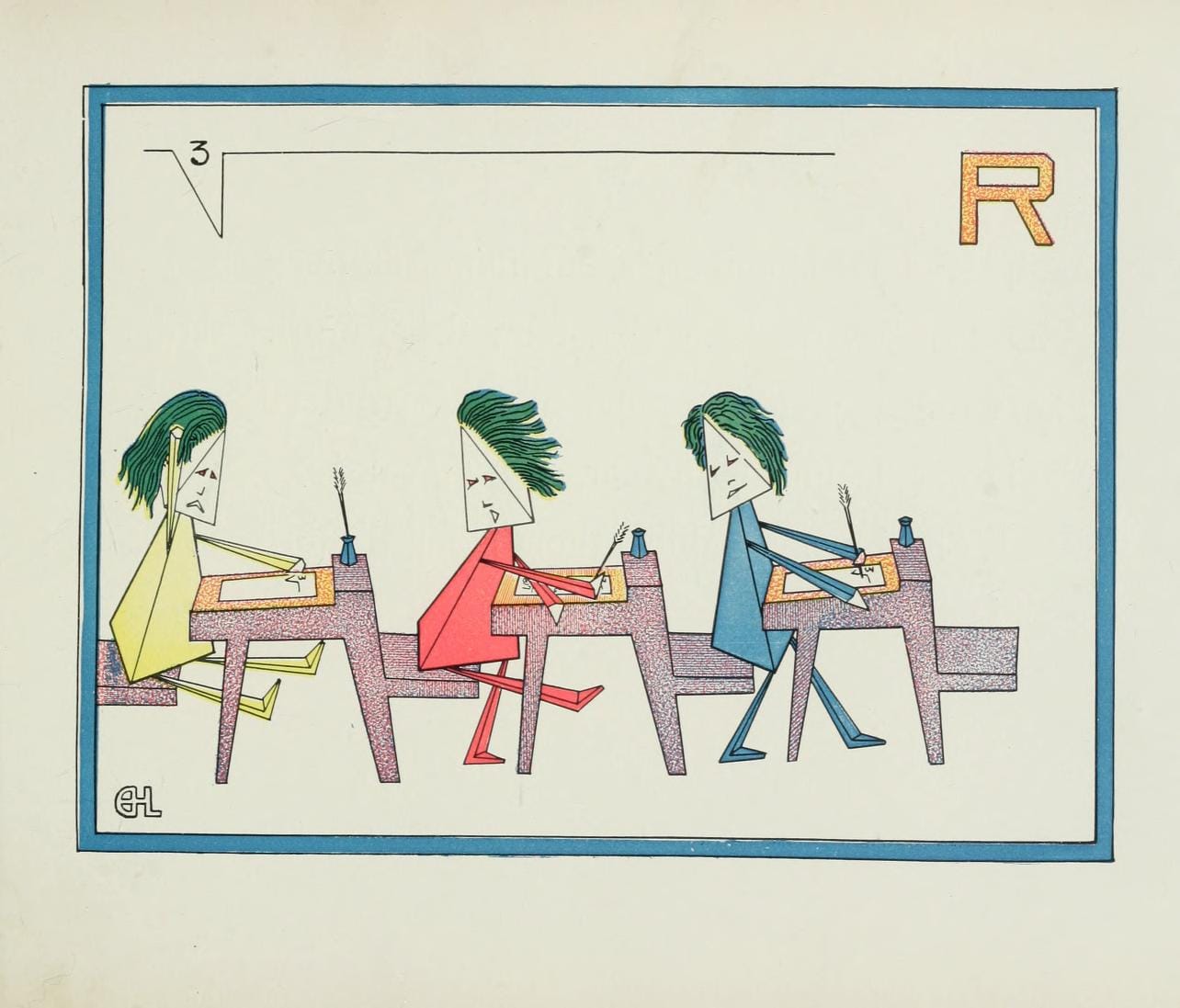
At one time the point of going to university was simply to get an education. To acquire a broad understanding of history, philosophy, literature; to simply steep yourself in learning for a few years in order to become a well-rounded gentleman.
Because you were a gentleman, if you were at university during this time.
There is a crisis in higher education right now. Specifically with higher education in the arts and humanities. There are subjects that are being dismissed as trivial. It's a waste of time to study french literature; how will it help you find a job? Much better to study something useful. Learn to code, study finance, do business things for business purposes.
It's easy to decry this situation as tragic – especially now, when the world is dominated by tech billionaires and MBAs whose catastrophic lack of any understanding of what it means to be human is causing untold damage and serving as a potent advertisement for a liberal arts education.
Wouldn't it be nice to go back to an age when you studied just to learn? Wouldn't it be nice if the point of higher education was to grow into a wiser, more curious person?
It is unjust that the moment a university education was made available to people who weren't men of the gentry it starting shifting into simply the route to a career. Everyone, regardless of class or financial situation deserves to spend a few years lolling about on the lawn discussing Chaucer!
But if you don't own a vast estate with tenant farmers providing you with an income, you do actually need to find a job, once your degree is in your hand. So you do actually need a qualification that will help you to do that.
There is an obvious problem in how readily the MBA pilled chuds who run the world right now dismiss the arts and humanities as a waste of time. If they continue to be successful in stripping funding from those areas, in persuading the next couple of generations of students to study something more "practical," I think we'll start to see that problem displayed in full force. I think we are underestimating how many important jobs require a solid grounding in the humanities.
But even if we recognised that, even if we stopped dismissing this entire realm of human knowledge as inessential for employment, that still leaves us with the problem of too many people not learning about art and history and philosophy. It still leaves us with the problem that, in the modern world, the only reason to be educated is so that you can be employed.
I think that's bad for the world. That's how you end up with the billionaires who run this town cheerfully asserting that introspection is a fake idea that was invented in the 1910s, I am not kidding, this is real, this is a real thing. Marc Andreessen insists that none of the great men of history ever engaged in introspection – embarrassing himself in front of the whole internet when a passing awareness of Socrates could have saved him.
In an ideal world people would simply be motivated to learn stuff for the fun of it. They'd read for pleasure – both fun and challenging books because sometimes you want to be diverted and sometimes you want to be satisfied.
There are, in my opinion, three barriers to this currently.
The first is simply the poor spinster cousin of arts degrees are a waste. Leisure time feels like something you're supposed to spend on either pure entertainment, or keeping on your grind. You watch a Spider-Man or you read a financial self-help book because those things are cool and alpha. You don't want to fart around with classic literature like some kind of cuck, do you?
I realise this fashion is probably not prevalent among people you or I know, but unfortunately it is extremely common in the MBA-pilled chuds who seem to be making all the decisions around here, so it must die. I don't know how to kill it, I have never been ahead of or on top of a trend in my life, but it must die.
The second barrier is that, once again, my god, are we not all so exhausted all the time. There's no need to relitigate that, we all know it! Costs too high, wages too low, fascism etc. It's too much to ask that we spend our weekends expanding our minds instead of lying limply on the couch, to tired to decide what to put on the TV.
So obviously we need some massive economic reforms to rebalance distribution of wealth. Fine.
But once we've managed to make reading cool again, and once we've addressed economic imbalances enough to give people leisure time and the energy to enjoy it we'll need to address the third barrier: education. Not university, the whole deal.
So much about how we teach the arts and humanities is alienating. My first real introduction to Shakespeare was being made to read aloud, as a class, through Julius Caesar when I was thirteen. The choice of play aside I don't think this is unusual.
You stumble over all those unusual words and then you listen to some other kid stumble over them, and it's boring and hard – even for me! A girly swat who was reading Henry V for pleasure a year later!
Wouldn't it be better if the job was less to teach a 30 odd teenagers what happens in Julius Caesar and more to help them find a way to enjoy it?
I don't think this is the fault of teachers, by the way. It's one more economic problem. Classes are too big, you have to pitch to the vague middle, you don't have time, I mean, my god, you're paying for your own whiteboard markers! But I think it would be so great if high school English was less focussed on teaching set texts and more on how to widen kids' horizons.
Teach a kid who loves comics who to recognise theme and symbolism in comics and tell them to read The Amazing Adventures of Kavalier & Clay. Teach them to go down the rabbit hole of influences, from Star Wars to Kurosawa, to Macbeth.
There are versions of this in most subjects, I think. We should be teaching kids statistics so they know how data can be interpreted in different ways for different reasons.
We should be teaching kids less about historical events and more about how the way we talk about those events has changed over time.
Stop teaching facts and start teaching how to find and interpret information.
Teach kids to learn. Teach them to enjoy learning and to seek it out of their own volition.
Difficult, expensive, will take a lot of long term investment, but I think we could do it! And that's how you end up living in a world where curiosity and scholarship is an everyday, ordinary thing that people do sometimes on their days off. And that's how you end up living in a world run by people with some degree of understanding of the concept of humanity.
Which I think would be nice.